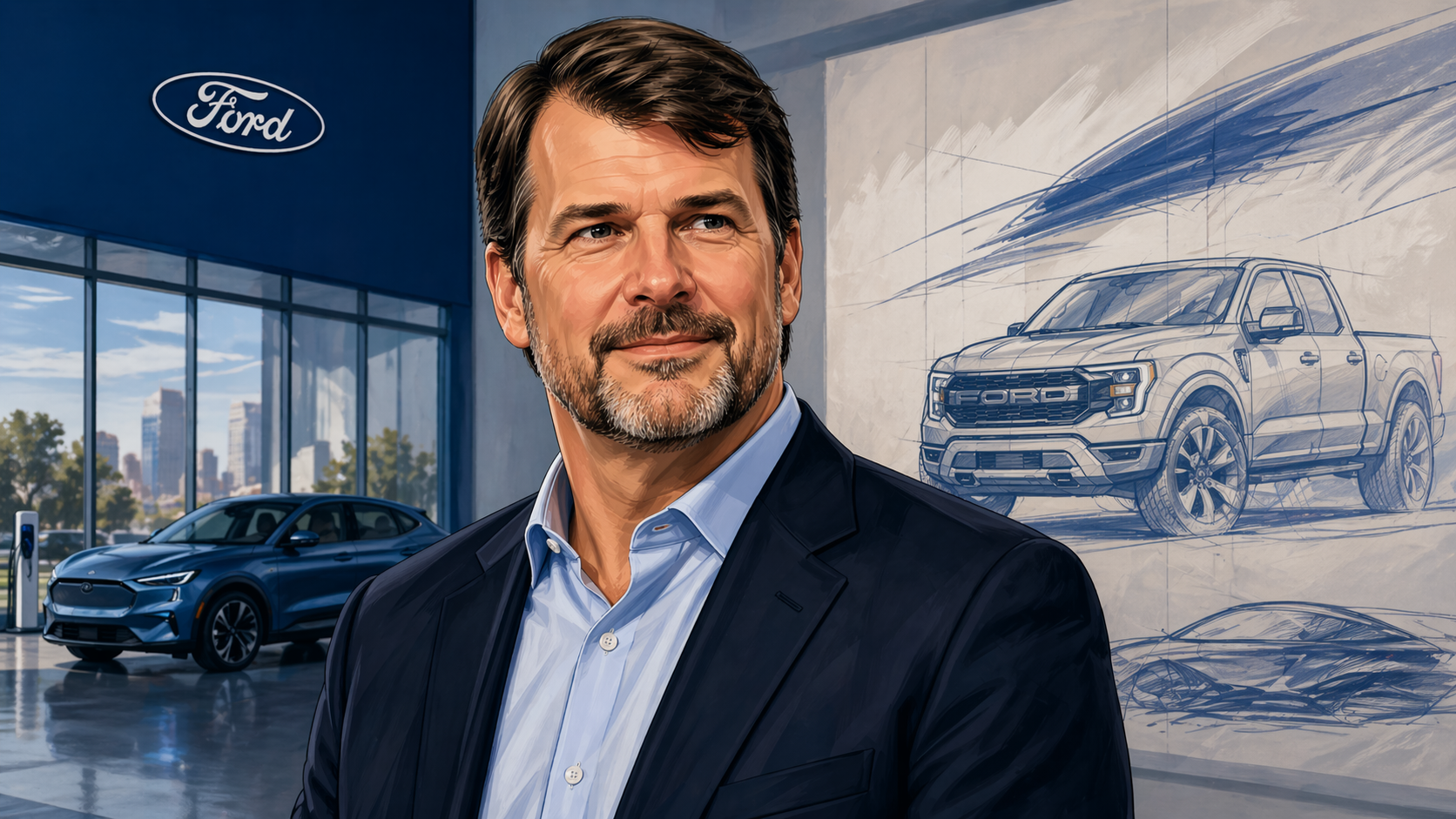
Jim Farley is one of the most striking personalities in contemporary automotive leadership — an industry insider by formation, an enthusiast by temperament, and a disruptor by conviction. Born on June 10, 1962, in Buenos Aires, Argentina, to American parents, he holds American citizenship and brings to the Ford CEO role a career shaped by fifteen years at Toyota, a deep passion for motorsport, and an increasingly urgent belief that the automotive industry must reinvent itself to survive the transition to electrification and autonomy. Since succeeding Jim Hackett in October 2020, he has moved with uncommon speed and decisiveness to reshape one of America's most storied corporations.
Formation and Academic Background
James D. Farley Jr. pursued his higher education in the United States, studying business administration at UCLA before earning an MBA from the University of Michigan — one of the most prestigious business schools in the country for students seeking careers in the automotive industry, given its proximity to Detroit and its deep ties to the sector's major employers. This academic foundation gave Farley both the financial and strategic frameworks he would apply throughout a career in one of the world's most capital-intensive and cyclically complex industries.
His academic preparation, however, was always balanced by a genuine passion for cars and motorsport that distinguishes him from the more financially-oriented profiles that often populate the top of large automotive corporations. Farley is a racing enthusiast who has competed himself in vintage car events — a dimension of his personality that informs his instinct for the products Ford makes and his ability to connect with both engineering teams and car-passionate customers.
Career at Toyota and Rise at Ford
Before joining Ford, Farley spent fifteen formative years at Toyota and its Lexus luxury division, primarily in marketing and brand leadership roles in North America. His time at Toyota gave him an intimate understanding of how a non-American automaker had successfully penetrated and ultimately come to dominate large segments of the American market — lessons in product quality, customer focus, and long-term brand building that he would later bring to his work at Ford.
He joined Ford in 2007 as group vice president of marketing, sales, and service — a period during which he played a key role in the company's communications strategy through the financial crisis of 2008-2009, when Ford chose not to accept a government bailout, a decision that ultimately strengthened the brand's image among American consumers. Over the following decade, he advanced through a series of senior executive roles, including leadership of Ford's European operations and various responsibilities in the company's Detroit headquarters, before being named President and CEO in October 2020.
Passion for Autonomous and Electric Vehicles
Since taking charge of Ford, Farley has made the electrification and autonomy of the vehicle fleet the central strategic pillars of his leadership. His most visible early move was the launch of the Mustang Mach-E — an all-electric SUV that deliberately borrowed the emotional power of the Mustang nameplate to signal that Ford's electric future would not sacrifice excitement for sustainability. The Mach-E has been followed by the all-electric F-150 Lightning pickup truck, targeting the segment where Ford holds its most dominant market position and where the transition to electric power carries the greatest symbolic weight.
Farley restructured Ford's business into three distinct segments: Ford Blue (internal combustion vehicles), Ford Model e (electric vehicles), and Ford Pro (commercial vehicles and services) — a reorganisation designed to give the electric vehicle business the management focus, capital, and cultural environment it needs to succeed against dedicated EV competitors like Tesla, while protecting the profitability of the existing business that funds the transition.
In a gesture that attracted considerable attention, Farley has been photographed driving a Chinese Xiaomi SU7 electric vehicle — a deliberate act of competitive intelligence and personal curiosity that reflects his approach to leadership: understanding the competition from the inside, not just from analyst reports. This willingness to engage directly with the future of mobility, wherever it is being built, defines a CEO who is as interested in the technology as in the business case — and who sees both as inseparable from Ford's long-term survival and success.