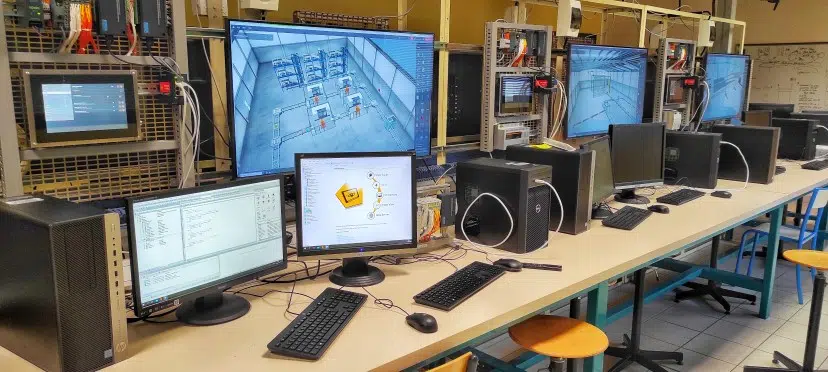
Industrial computing represents a specialised branch of applied computing focused on the design, analysis, and programming of computerised systems operating within industrial environments. Unlike general-purpose computing, which prioritises versatility and user interaction, industrial computing is built around the demands of physical production: reliability under harsh conditions, deterministic real-time response, and seamless connectivity with machinery, sensors, and control systems. The emergence of Industry 4.0 has dramatically amplified the scope and strategic importance of industrial computing, embedding it at the heart of the digital transformation of manufacturing through artificial intelligence, the Industrial Internet of Things (IIoT), and advanced data analytics.
What is Industrial Computing?
At its core, industrial computing covers all the hardware and software technologies used to monitor, control, and optimise industrial processes. This encompasses the design of embedded systems integrated directly into machines, the programming of programmable logic controllers (PLCs) that govern automated production lines, and the development of supervisory control and data acquisition (SCADA) systems that provide operators with real-time visibility into plant-floor operations.
A defining characteristic of industrial computing is the requirement for real-time performance — the ability of a system to respond to events within short, predictable timeframes. In a conventional office computing environment, a delay of a few seconds is an inconvenience. On a production line or in a chemical process, the same delay can mean defective products, safety incidents, or catastrophic equipment failures. Industrial computing systems are therefore engineered to guarantee response times and to maintain continuous operation even in the presence of electrical noise, vibration, temperature extremes, and other environmental stresses that would disable commercial-grade equipment.
Key Concepts and Technologies
Embedded Systems are computer systems integrated directly into machines and equipment to perform specific control or monitoring functions. They operate continuously, often without human intervention, managing everything from the temperature of an industrial oven to the positioning accuracy of a robotic arm. Their design prioritises reliability, low power consumption, and deterministic behaviour over raw computational power.
Industrial Software encompasses the applications used to automate and optimise manufacturing operations. This includes manufacturing execution systems (MES) that track production in real time, enterprise resource planning (ERP) systems that integrate inventory, logistics, and production scheduling, and advanced process control (APC) tools that use mathematical models to continuously optimise process variables.
OPC-UA (Open Platform Communications Unified Architecture) is the industry-standard protocol for secure, reliable data exchange between industrial devices and software systems. By enabling interoperability across different manufacturers' equipment and software platforms, OPC-UA is a foundational enabler of the connected factory — allowing data generated on the shop floor to flow seamlessly into enterprise-level analytics and decision-making tools.
Cybersecurity has become an increasingly critical dimension of industrial computing as connectivity increases. Connected industrial systems represent attractive targets for cyberattacks — from ransomware that halts production to sophisticated intrusions targeting process control systems. Industrial cybersecurity encompasses network segmentation, access control, real-time threat monitoring, and secure software update processes, all designed to protect operational continuity and data integrity without compromising system performance.
Industrial Computing in the Era of Industry 4.0
The fourth industrial revolution — Industry 4.0 — has fundamentally expanded the role of industrial computing. The integration of IIoT sensors across production environments generates vast streams of operational data that, when processed and analysed effectively, enable entirely new capabilities: predictive maintenance that anticipates equipment failures before they occur, dynamic production scheduling that responds in real time to demand signals, and quality control systems that use machine vision and artificial intelligence to detect defects at speeds no human inspector could match.
Data analysis has become fundamental to industrial performance optimisation. Big data technologies and analytical platforms allow manufacturers to process and interpret the enormous volumes of information generated by connected production environments, identifying patterns, inefficiencies, and improvement opportunities that would be invisible to conventional monitoring approaches. This analytical capability is transforming industrial computing from a purely operational discipline into a strategic driver of competitive advantage.
Fab Labs — digital fabrication laboratories equipped with additive manufacturing, laser cutting, and other advanced tools — represent another frontier where industrial computing intersects with innovation. These environments enable rapid prototyping and iterative product development that was previously accessible only to large organisations with significant capital resources, democratising manufacturing innovation across the industrial ecosystem.
As industrial computing continues to evolve, its challenges — ensuring cybersecurity in increasingly connected environments, developing the specialised skills required to design and maintain complex systems, and integrating new digital technologies with legacy equipment — will remain central concerns for manufacturers navigating the transition to smarter, more connected production.