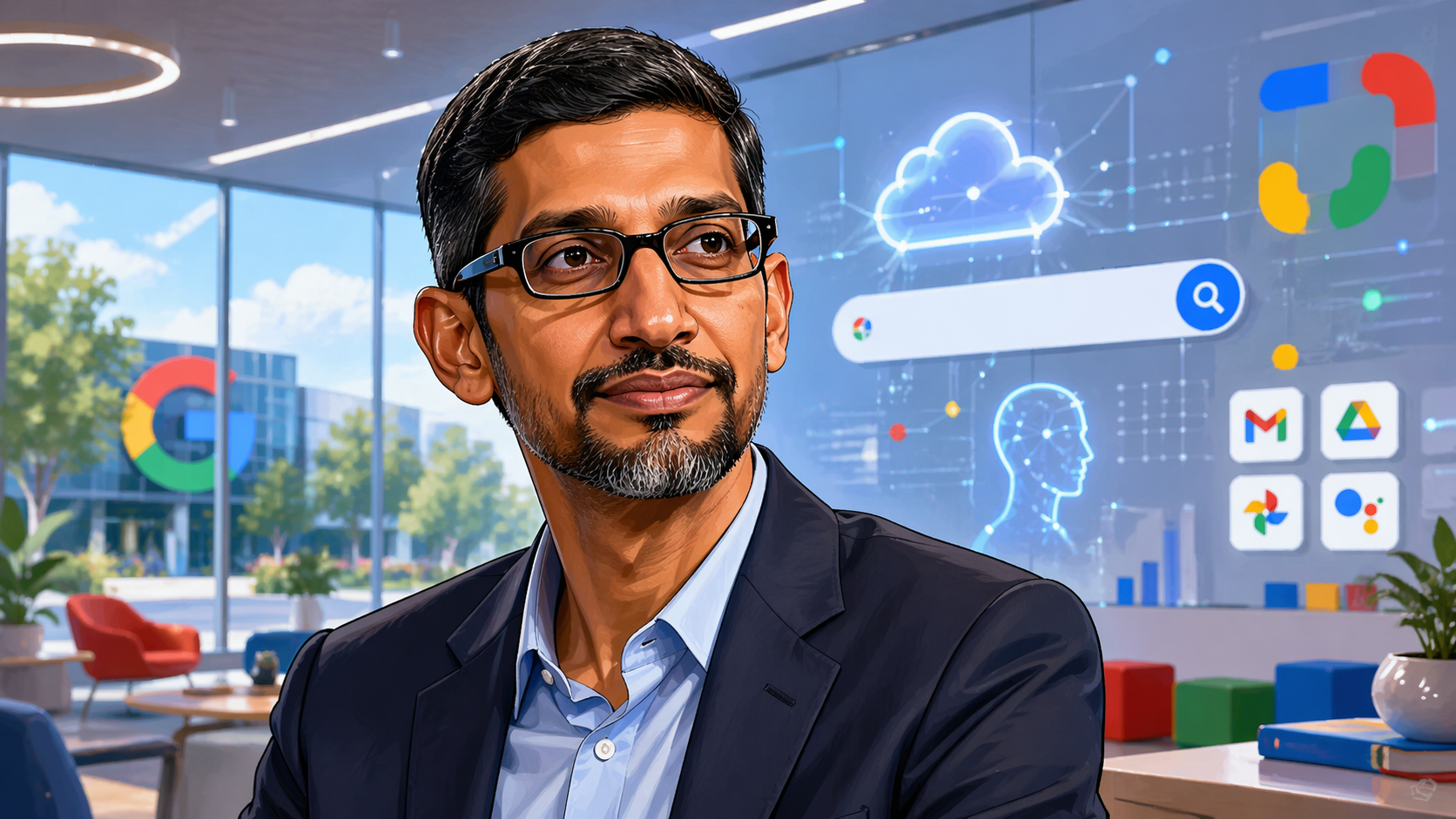
Sundar Pichai, born Pichai Sundararajan, is a visionary leader whose journey has marked the world of technology in ways that extend far beyond the company he leads. His career trajectory — from a childhood in Chennai without a refrigerator or car in the family home, through the most prestigious engineering and business institutions in the world, to the chief executive office of Google — represents one of the most striking personal stories in the history of Silicon Valley. It is a story of exceptional intellectual gifts, strategic clarity, and a quiet determination that has proven more durable than the more flamboyant leadership styles that often command attention in the technology industry.
Background and Education
Sundar Pichai was born on June 10, 1972, in Madurai, Tamil Nadu, India, in a family of modest means. His father, Regunatha Pichai, worked as an electrical engineer at GEC (General Electric Company) in India, while his mother, Lakshmi, was a stenographer. The household had no telephone until Sundar was twelve years old — a detail that makes his subsequent role in shaping global communications technology all the more remarkable. From an early age, he displayed an exceptional aptitude for mathematics and sciences, as well as a remarkable memory for numbers that his family still recalls with admiration.
He earned a degree in metallurgy from the Indian Institute of Technology Kharagpur — one of India's most selective engineering institutions — graduating with a silver medal that placed him among the top students of his class. A scholarship then took him to Stanford University, where he completed a Master's degree in Materials Science and Engineering. His intellectual trajectory then took a decisive turn toward business and strategy with an MBA from the Wharton School of the University of Pennsylvania, one of the world's leading business programmes. This combination of deep engineering training and elite business education would prove perfectly suited to the challenges of leading a technology company simultaneously at the frontier of computer science and global commerce.
Career at Google and Rise to the Top
Pichai joined Google in 2004, initially working on the Google Toolbar — a browser extension that introduced millions of users to Google's search capabilities without leaving the browsers they already used. This early role gave him a direct understanding of how Google's products interacted with the broader computing ecosystem, and more importantly, a clear view of what Google lacked: a browser of its own. His most celebrated early contribution to Google was conceiving and leading the development of Google Chrome, launched in 2008. Chrome became the world's most used web browser — surpassing Internet Explorer, Firefox, and Safari to command a dominant share of the global browser market — and its success reshaped the competitive dynamics of the entire software industry.
The development of Chrome demonstrated capabilities that Larry Page and Sergey Brin recognised as essential for Google's future: the ability to ship products of exceptional technical quality on ambitious timelines, with a clear user-centred philosophy. Pichai was promoted steadily through Google's leadership ranks, taking on responsibility for an expanding portfolio of products before being named CEO of Google in August 2015, when Page restructured the company and created Alphabet as the parent holding entity. In December 2019, Pichai was appointed CEO of Alphabet as well, consolidating his authority over Google's entire corporate family — a recognition of his effectiveness in managing a company of extraordinary complexity and global impact.
Innovation, AI, and a Vision for the Future
Under Pichai's leadership, Google has intensified its commitment to artificial intelligence as the defining technology of its next era — a commitment that predates the public explosion of interest in AI triggered by ChatGPT but has been substantially accelerated by it. Google's investments in DeepMind, its development of the Transformer architecture that underlies the current generation of large language models, and its rapid deployment of AI capabilities across Search, Maps, Gmail, and its Workspace productivity suite reflect a strategic bet that AI will remain the primary axis of competition in global technology for the foreseeable future.
Pichai has also positioned Google Cloud as a serious competitor to Amazon Web Services and Microsoft Azure — a transformation from the company's earlier years when cloud infrastructure was not a strategic priority. The launch of Google Assistant, designed to compete with Siri and Alexa with advanced natural language processing and deep integration with Google's information graph, represents another dimension of this strategy: bringing Google's AI capabilities directly into the daily lives of users through conversational interfaces and smart device integration. His vision for Google's future rests on developing AI tools that genuinely improve users' quality of life, establishing Google Cloud as a provider of robust enterprise solutions, and committing to sustainability — with ambitious targets for renewable energy use and carbon reduction across Google's global operations. Throughout, Pichai has been consistent in his emphasis on maintaining high ethical standards in AI development, implementing governance frameworks for responsible AI that he believes are inseparable from the company's long-term credibility and commercial success.